
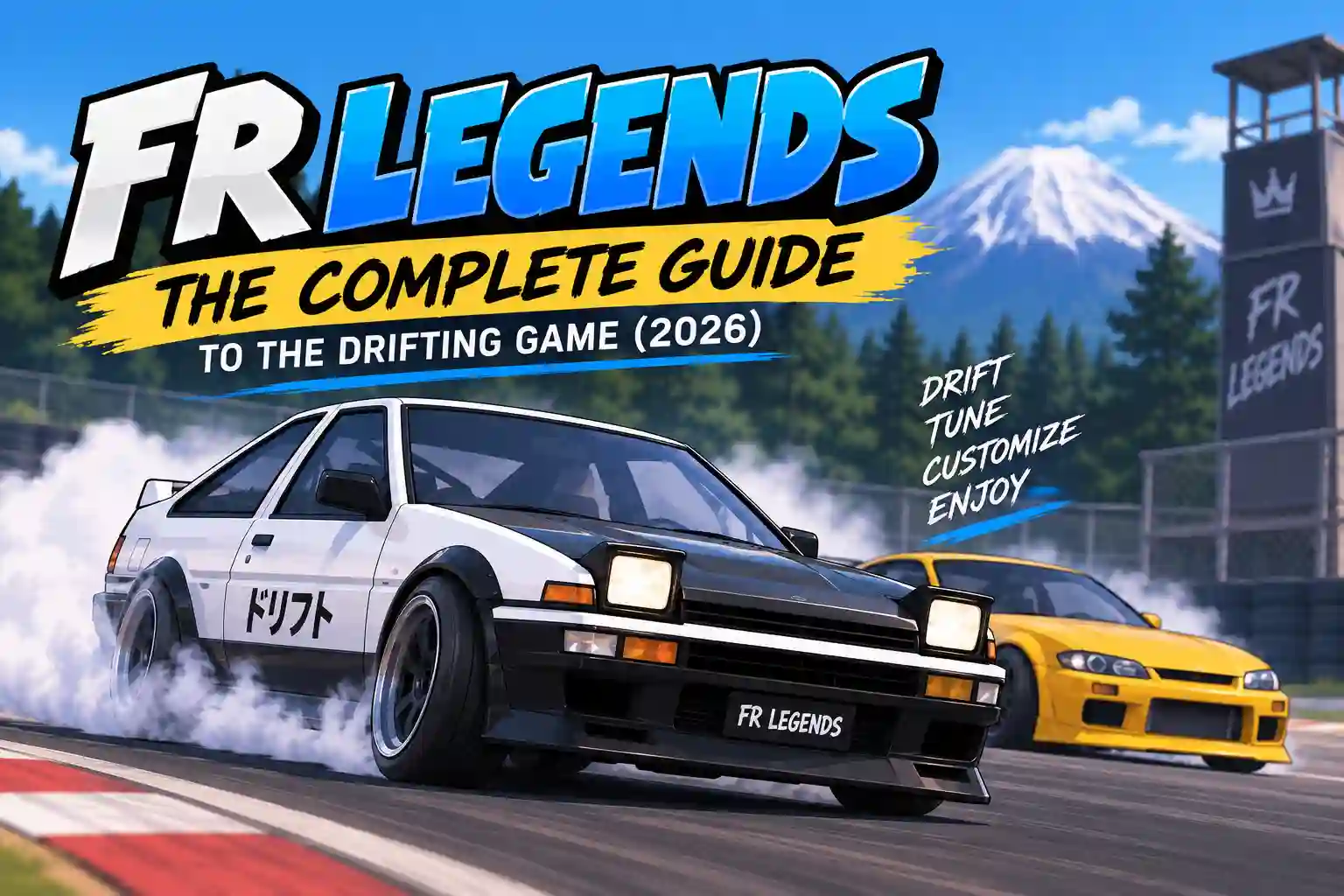
FR Legends: The Complete Guide to the Drifting Game (2026)
If you have ever watched a car slide sideways through a mountain corner and wondered how anyone controls that on a phone screen, FR Legends is the game that answers that question. FR Legends is a mobile drifting game built around front-engine, rear-wheel-drive cars, real drift scoring rules, and a level of car customization that most console racing games do not even attempt.
It was created by 丰 李, credited on the App Store under the name feng&iiley, and it has held a strong 4.3 out of 5 rating across roughly thirteen thousand reviews since it first launched back in 2018. This guide walks through everything a new or returning player actually needs: how the scoring works, which cars suit which driving style, how to tune a car so it stops spinning out, and what has changed in the game recently.
What Is FR Legends
Fr Legends is a drifting game puts you behind the wheel of FR cars, meaning front-engine, rear-wheel-drive, which is the same layout that real drift cars use on actual drift circuits around the world. Instead of racing to a finish line, you earn points for how well you hold an angle, follow a line, and stay close to another car without touching it.
Detail
Verified Fact
| Developer | 丰 李 (feng&iiley) |
| First released | 2018 |
| Platforms | iOS and Android |
| Price | Free, with optional purchases |
| App Store rating | 4.3 out of 5, around 13,000 |
| Age rating | 13+ |
A quick note before we go further: several other sites list a different company name for the developer, along with download numbers that cannot be checked anywhere. This guide sticks to what the official App Store listing actually shows, so every fact here can be traced back to a real source rather than a guess dressed up as a statistic.
FR Legends Developer and Game History
The developer behind this drift title has kept things small and steady rather than chasing hype. Since the 2018 launch, updates have arrived in a slow, continuous stream, adding one new car here, fixing a lighting bug there, rather than dropping one giant overhaul and disappearing for a year. That pattern is actually a good sign for a mobile game, since it usually means the person or team behind it is still genuinely invested in the project rather than milking an old release.
A question that comes up constantly in the community is whether an FR Legends 2 or a third installment exists. As of now, there is no officially announced sequel. Any listing using those names is almost always a fan project, a mislabeled copy, or an unrelated app trying to ride on the original’s popularity.
How the FR Legends Scoring System Actually Works
This is the part that separates this drift game from a typical racing game, and it is also where most new players lose points without understanding why. Every run is judged the same way real drift competitions are judged, using four connected factors: angle, line, speed, and proximity.
What Affects Your Drift Score
Angle measures how far sideways your car is sliding through a corner, but holding a huge angle for half a second does not score well on its own. The game wants that angle sustained smoothly, not flashed briefly and lost. Line refers to how closely your path matches the ideal route through a course, including the clipping points scattered along the track. Speed rewards keeping momentum through the drift instead of scrubbing it all away mid-corner, and proximity comes into play heavily during tandem battles, where staying close to the lead car without making contact adds serious points.
How You Lose Points
On top of those four factors, the game quietly deducts points for straightening out unexpectedly, drifting in the wrong direction, or clipping a wall too hard. Here is the detail most beginners miss completely: a slower, more controlled drift that holds its angle cleanly through the exit will almost always outscore a wild, fast drift that slides wide and loses the line. Consistency beats maximum angle every single time, which is exactly how real drift judging works too.
Controls and Steering Options
This mobile drift title runs entirely on touch input, and there is no official controller support built into the mobile app itself. You get three steering options to choose from:
- Tilt Steering: Uses your device’s accelerometer to control the car.
- Slider Steering: Gives you a smooth on-screen steering bar.
- Button Steering: Uses simple left and right taps to steer.
Most players run into one of two problems early on. Either the steering feels twitchy, snapping the car into an uncontrollable slide the moment you touch the screen, or it feels numb, refusing to break the rear end loose when you actually want it to.
There is no single perfect sensitivity setting for everyone. It depends on your screen size, your device’s responsiveness, and simply how your thumbs move.
For better sensitivity:
- Run the same corner in Practice mode several times without changing anything else.
- If you are over-rotating, lower the sensitivity slightly.
- If the car fails to initiate cleanly, increase the sensitivity slightly.
- Repeat the process until your steering inputs feel predictable.
Once your inputs feel predictable, tune the car around that feel rather than chasing a sensitivity number someone else recommends online.
Game Modes Explained
The game splits its content into several modes, and each one is quietly teaching you a different skill.
Mode
What It Teaches
| Practice | Learning a new car or track with zero scoring pressure |
| Solo Run | Scored drifting alone, the main early way to earn cash |
| Gymkhana | Tight, technical courses and a fast route to in-game money |
| Tandem Battle | Leading or chasing another car, scored on angle and proximity |
| Touge Attack | Grip-based mountain driving rather than pure drift scoring |
| Championship | A structured event series tying multiple modes together |
| Multiplayer | Online battles and free-running against real players |
| Custom Tracks | Community-built layouts with saved replays and leaderboards |
Note: New players often jump straight into online multiplayer battles before they are ready, and the skill gap can be discouraging fast. Spending real time in Practice and Solo Run first builds the throttle control that Battle and Championship modes are actually built around rewarding.
FR Legends Car Roster
Every car in the garage shares the same front-engine, rear-wheel-drive layout, which is the whole point of the game’s name. The confirmed lineup draws heavily from real Japanese drift-scene platforms.
Cars
Chassis Codes
| Toyota AE86 | AE86 |
| Toyota GT86 / Subaru BRZ platform | ZN6 |
| Toyota Chaser | JZX100 |
| Nissan Silvia | S13, S14, S15 |
| Nissan Skyline GT-R | R32, R33, R34 |
| Mazda RX-7 | FC3S, FD3S |
| BMW 3 Series | E30, E36 |
Lighter cars like the AE86 rotate quickly and reward precise, careful inputs, which is why the community almost always recommends them as a starting point. Heavier, more powerful cars like BMW M4 carry momentum through longer transitions, punishing a late correction much harder while rewarding a driver who has already built solid habits.
One useful thing to know before spending your first big paycheck: in-game price tends to follow unlock order rather than actual drifting performance, so a cheap early car tuned properly can genuinely outscore an expensive one left on stock settings.
Tuning Fundamentals: What Order to Adjust Things In
Owning a fast car matters far less than knowing how to set it up, and this is where most guides stop short. Tune in this order for the best results.
Tire Compound and Pressure
Start with tire compound and pressure, since this single setting shapes most of how the car behaves before you touch anything else.
Camber
From there, adjust camber: more negative front camber sharpens steering response on initiation, while rear camber is usually kept closer to neutral to keep the back end predictable mid-slide.
Suspension
Suspension comes next, where a softer front end smooths out initiation for beginners and a stiffer rear end helps heavier, higher-powered cars resist snapping into oversteer.
Steering Angle
Steering angle follows, with more lock helping you catch and hold longer drifts on tight tracks, while flowing tracks sometimes benefit from slightly less lock for stability.
Gear Ratios
Gear ratios come last: shorter ratios suit tight, technical courses full of quick re-commitments, while longer final gears keep flowing tracks in the power band without constant shifting mid-drift.
Engine Swaps
Engine swaps add another layer of character on top of all this. The 2JZ favors high-horsepower builds with strong top-end pull, the RB26 is known for a punchy mid-range, the SR20 is lighter and more responsive, and the CA18DET trades raw power for reduced weight. Exact output numbers shift between updates, so treat these as general personality traits rather than fixed figures. One habit worth building early: save your tuning setups as named presets tied to a specific track and power level, so you are never rebuilding a setup from memory before a session.
FR Legends Tracks
The track list leans into real-world drift culture rather than generic racing circuits, and it has grown steadily through updates over the years. Confirmed additions from official patch notes include Hiroshima, a realistic urban-inspired course, and USAIR Motorsports Raceway, a more open-world style layout. Alongside these, the community regularly references touge-style mountain courses and technical, tight-radius layouts as staples of the track rotation. New players generally start on the simpler, lower-grip layouts before moving to technical, elevation-heavy courses once initiation timing feels natural.
Customization and Livery System
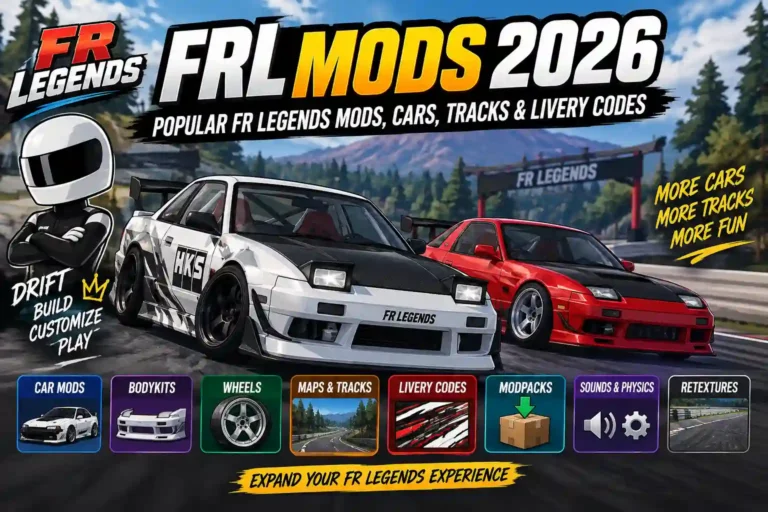
This is arguably where the game separates itself furthest from other mobile racers. The livery codes supports layered custom paint, a large sticker library, body kits, wide-body panels, wheels, ride height, and interior details like seats and harnesses modeled after real aftermarket brands.
Features like undo and redo support, layer grouping, and minor move buttons give the editor a level of polish you would not expect from a free mobile game, and it is a major reason the player base has stuck around for years past launch.
What’s New in 2026
Rather than one massive overhaul, recent updates have arrived as a steady stream of smaller improvements. Confirmed changes from the last several patches include fog rendering support alongside related lighting fixes, a new harness system option, an easy drone camera mode, decreased tire prices, and continued refinement of the custom tracks feature, which now supports saved replays and online leaderboards.
Livery rendering bugs, car modeling issues, and multiplayer connection problems have also been steadily patched out. This pattern, frequent small fixes rather than rare giant updates, is consistent with how the game has been maintained since 2018.
Is It Safe to Download FR Legends Mod APKs
You will find plenty of sites offering a modified version of FR Legends with unlimited money and every car unlocked for free. It is worth understanding what that actually costs you before downloading one. Using a modified APK violates the game’s terms of service, and if you touch any online feature while using one, your account can be banned outright.
Beyond that, sideloaded APK files from unofficial websites are a well-known way malware gets onto Android devices, and there is no real way to verify what else has been packed into that file alongside the game. The good news is that you do not need a mod to progress quickly.
Beginner Tips That Actually Compound
Here are few tips for beginners
- Start with a light, cheap car, since control matters far more than horsepower early on
- Spend real time in Practice before touching Multiplayer to close the skill gap safely
- Tune tires and camber before anything else, since they shape most of the car’s behavior
- Chase a consistent line over maximum angle, because the scoring system rewards repeatability
- Use Gymkhana for early cash instead of grinding slower modes
- Save tuning presets by track and power level so nothing gets rebuilt from scratch
FAQ’S

Conclusion
FR Legends is more than a simple mobile racing game. Its focus on realistic drifting, detailed car tuning, customization, and competitive scoring gives every run something to learn. Whether you are practicing your first drift or improving your tandem battles, understanding the game’s mechanics makes a big difference.
Start with a car that feels easy to control, spend time in Practice mode, and adjust your tires, camber, suspension, and steering step by step. Once your setup feels predictable, you can move into harder tracks and game modes with more confidence. The key is not chasing maximum power or angle, but learning how to control the car smoothly and consistently.