
Top Engine Swaps in FR Legends Mod APK 2026: Full Guide, Compatibility & Tuning
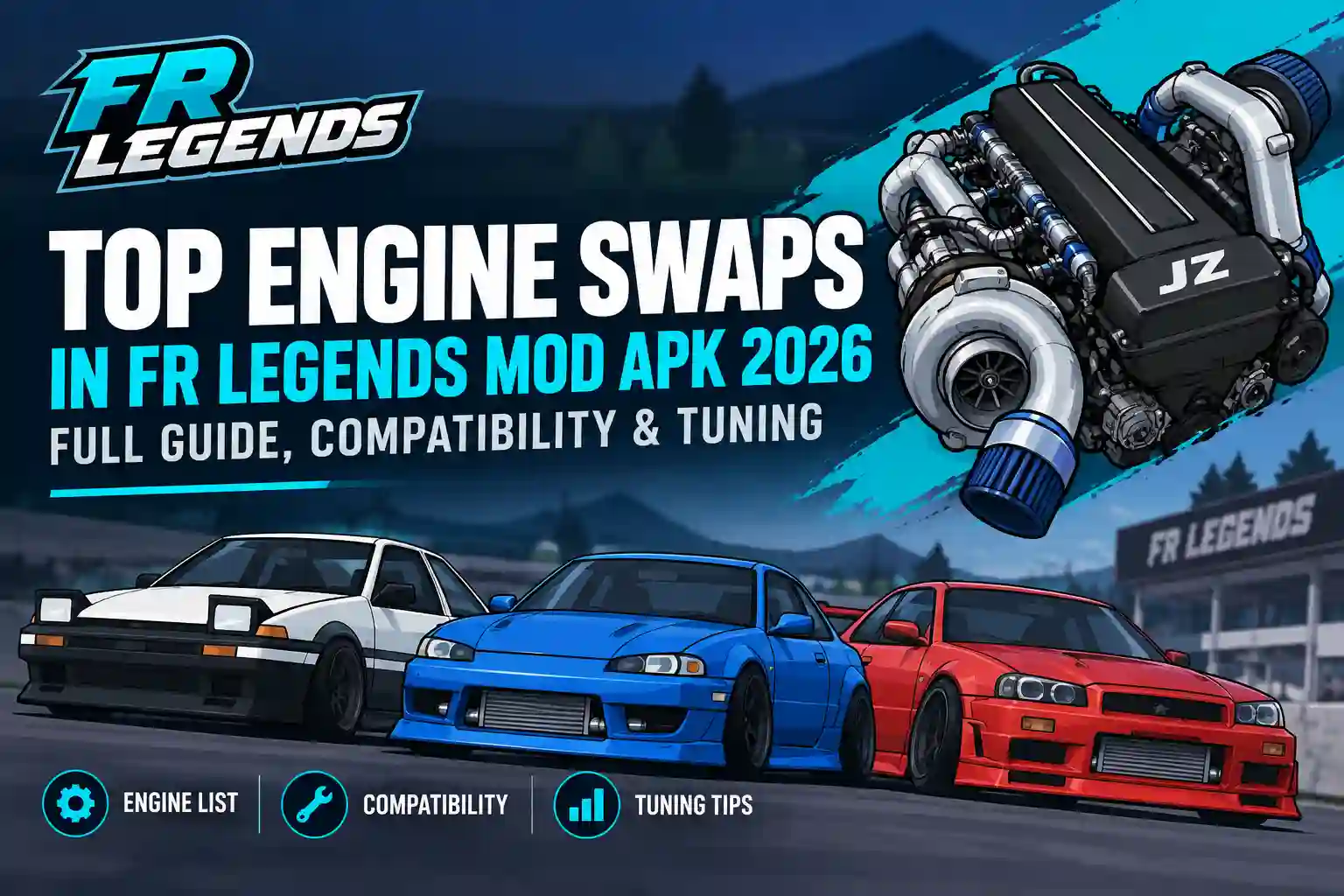
Many guides covering the top engine swaps in FR Legends Mod APK 2026 name engines like the 2JZ-GTE or LS V8 that the standard game does not list. FR Legends, made by Twin Turbo Games, uses short codes such as J, R25, and S20B instead, and each engine fits only certain cars. Power, weight, cost, and compatibility all move together, so the engine with the highest documented output is not automatically the right choice for every build. This guide to the top engine swaps in FR Legends Mod APK 2026 uses documented in-game engine names and the available engine data, so you can plan a build around what your car actually supports.
What Are Engine Swaps in FR Legends
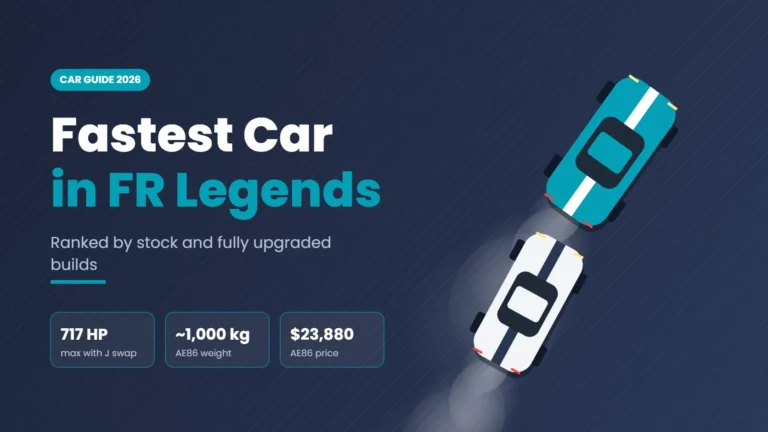
An engine swap replaces your car’s stock engine with another one from the game’s engine list. It changes power, weight, and maximum RPM, which changes how the car reacts to throttle mid-drift. A J swap in the AE86, for example, raises its ceiling to 717 HP, well above the 197 HP of its stock 4G.
FR Legends Engine List 2026
The game lists 15 engines: 1600, 3G, 4G, BP, F20, R25, REW, S20B, S20R, SA14, SA20, C18, J, BB, and 50. Stock power starts at 100 HP for the 1600 and tops out at the J’s 717 HP when fully upgraded. Some codes point to real-world engines — the 4G is based on the Toyota 4A-GE, and the C18 is based on the Nissan CA18DET. Swap options for the 1600, 3G, BP, F20, SA14, and SA20 are not documented well enough to chart here, so check those directly in your engine menu.
Top Engine Swaps in FR Legends Mod APK 2026
These seven engines are ordered by power ceiling, with fitment and cost added where the data supports it.
J Engine – High-Power Straight-Six
The J is a straight-six based on the Toyota 1JZ, not the 2JZ-GTE that many mod sites name. It costs $16,000, makes 275 HP stock, and can reach 717 HP with the stock turbo kit or Turbo Kit 1. Its maximum RPM also rises from 7,500 to 8,500 as you upgrade it. The J comes stock in the JZX100 Mark II and Chaser, and it’s available to most non-rotary cars — see the compatibility chart below for the full list. Cost is the catch, since the top upgrade level of each part uses Gold, the premium currency.
R25 Engine – R32-Focused Straight-Six
The R25 is based on the Nissan RB25 and comes stock in the R32 Skyline, in both 2-door and 4-door form. It makes 220 HP, revs to 7,500 RPM, costs $8,000, and reaches around 460 HP fully upgraded. At 230 kg, it’s the heaviest engine in this list. The R32 can also take the J, which is 65 kg lighter on paper, so R32 owners have a documented choice between the stock engine and a much higher ceiling.
S20B Engine – Lightweight Four-Cylinder
The S20B is the SR20 blacktop, stock in the S15 and swappable into the S13, S14, 180SX, and Altezza. It makes 220 HP from 150 kg, costs $6,400, and the available data lists it as the highest-output stock four-cylinder in the game. Fully upgraded, it reaches around 460 HP.
S20R Engine – High-Revving Four-Cylinder
The S20R is the SR20 redtop, stock in the S14 and swappable into the S13, 180SX, and Altezza. It costs $4,800 and makes 202 HP from 145 kg. Its stock RPM limit of about 7,500 is higher than the S20B’s roughly 7,000, and it reaches around 442 HP fully upgraded.
REW Engine – High-Power Rotary
The REW is the twin-rotor engine, based on the Mazda 13B-REW, that the RX-7 FD3S runs stock. It makes 276 HP, weighs an estimated 155 kg, revs to 8,500 RPM, and costs $10,000. It fits only the FD3S, and the FD cannot take a J, so its ceiling of about 715 HP sits just short of the J’s 717 HP. Any FD3S build is about tuning the rotary, not replacing it.
BB Engine – FC Rotary Setup
The BB is listed as a rotary making 202 HP stock at an estimated 153 kg. With its turbo setup it can reach about 617 HP, well below the REW but a large jump from stock. The RX-7 FC cannot take a J, so a BB build means staying in the rotary family. Current data ties the BB to the FC, but confirm the fit in your own engine menu before buying.
50 Engine – BMW Straight-Six
The 50 is based on the BMW M50B25 and belongs to the E36. It makes 290 HP stock, weighs 162 kg, revs to about 7,600 RPM, and costs $8,000. Without a turbo kit, it tops out around 530 HP, well short of the J. The E36 can also take a J, so the decision is between a naturally aspirated build and a much higher power ceiling.
FR Legends Engine Swap Compatibility Chart
| Engine | S13/S14/S15 | R32/R33 | Supra/Chaser | AE86/Miata | E30/GT86 | Trucks |
|---|---|---|---|---|---|---|
| 2JZ | ✅ Elite | ✅ God | ✅ Native | ✅ Sleeper | ✅ Heavy | ⚠️ |
| RB26 | ✅ Native | ✅ Native | ✅ Perfect | ✅ Balanced | ✅ Torque | ✅ Canter |
| LS V8 | ✅ Fun | ❌ Heavy | ⚠️ | ✅ Ideal | ✅ Native | ✅ Tow |
| SR20 | ✅ Native | ⚠️ | ✅ Balanced | ✅ Light | ✅ Fun | ❌ |
| 4G63 | ✅ Turbo | ❌ | ✅ Punch | ✅ Evo86 | ❌ | ✅ L300 |
Why compatibility matters : Some cars, like the S15, currently have only one documented swap option, so there’s no real decision to make beyond buying it or staying stock. Engines like the R25 and 50 are tied to a single platform and do not swap elsewhere at all. Rotary cars follow their own rules and cannot take the J regardless of how much power it offers. Availability can also shift between game versions or modified builds, which is one more reason to check your own engine menu before committing gold to a swap. If you drive the Supra, you can also try our Supra MOD for a different take on the car.
Track-Specific Engine Recommendations
| Track | Best Engine | HP Target | Why It Wins |
|---|---|---|---|
| Ebisu Minami | RB26 | 550HP | Jump recovery power |
| Fujimi Kaido | 2JZ | 650HP | Touge torque |
| Osaka Loop | LS V8 | 500HP | Urban initiation |
| Touge Attack | SR20 | 420HP | Night precision |
| Hakone | K20 | 350HP | Flowing rhythm |
Engine Swaps for Different Goals
These are use-case notes, not a ranking. Which engine suits a build depends on the car, the track, and the driver.
For maximum power: The J has the highest documented ceiling at 717 HP. The REW follows at about 715 HP, but only inside the FD3S.
For drifting: Holding a long slide rewards power a driver can keep steady. A moderate S20B or S20R build can be easier to keep consistent than a fully upgraded J, depending on the driver’s throttle control.
For players newer to the game: The S20R can be a practical option because it costs $4,800 and starts at 202 HP, which is a lower figure to manage than the J’s 275 HP stock output.
For lightweight builds: Among the seven engines covered here, the S20R is lightest at 145 kg. The C18 (120 kg) weighs less still, but it’s limited to the Altezza.
For R32 builds: The J weighs 65 kg less than the stock R25 and raises the documented ceiling from about 460 HP to 717 HP. The R25 remains a documented option for players who want to stay closer to the car’s stock character.
For S-chassis builds: The S20B is a documented option for the S13, S14, and 180SX at a moderate power level. The J is available on the same cars for a higher ceiling.
For rotary builds: The REW in the FD3S, or the BB in the FC. Neither rotary car can take the J.
How Engine Swaps Change Drift Performance
A swap changes power, weight, RPM range, and how easily the rear tires break loose. A high-power J setup can suit long or high-speed slides, while a lighter S20B or S20R setup can be more manageable for a driver still learning throttle management. Higher output is not automatically an advantage, it is a trade-off that depends on how it’s tuned.
Power and throttle control: More power breaks traction sooner, so the same throttle input can push a J build into a spin where an S20B stays planted. Throttle precision matters more as output rises.
Engine weight and balance: The engine sits at the front of an FR car, so a heavier block adds front weight. The R25 weighs 230 kg against 165 kg for the J, which changes how the nose turns in.
Gear ratios: A higher RPM limit, like the J’s 8,500 RPM, lets each gear run longer before the limiter. Gearing should keep the engine in a useful range through the whole slide.
Differential settings: More power generally needs a differential that keeps the rear wheels working together under load. Too little lock can let one wheel spin and end the drift early.
Suspension and tires: Extra power loads the rear tires harder. Tire settings that worked on a weaker engine can lose grip once a stronger one is installed.
FR Legends Post-Swap Tuning Guide
Change one setting at a time and test after each change, so you know what actually caused the result.
Install and test first. Run a few laps with your old tune on the new engine before touching any settings. This shows exactly what’s broken and what still works.
Adjust gear ratios. Watch where the car hits the RPM limit. If it maxes out mid-slide, lengthen the gearing. If it bogs down, shorten it.
Tune the differential. Start from your old setting and move the lock in small steps. If the rear snaps loose or won’t hold angle, adjust and retest on the same corner.
Adjust suspension. A heavier or lighter engine shifts front weight, so recheck front spring and ride height. Small changes are enough to start.
Match tire grip to power. If the rear breaks loose too easily with the new engine, adjust tire settings before adding more power. Grip and power should grow together.
Test again, then add power. Only once the car feels settled should more output be added.
Common FR Legends Engine Swap Mistakes
Swapping without retuning. An old setup was built for the old engine’s weight and power. A swap can feel worse than stock until it’s retuned.
Chasing horsepower over control. A high power figure doesn’t help if the driver can’t hold angle. A controlled S20B build can produce cleaner runs than a J the driver keeps spinning out.
Ignoring engine weight. Looking only at HP hides the weight gap. The S20R weighs 145 kg and the R25 weighs 230 kg — an 85 kg difference that changes how the car turns in.
Ignoring cost. The J’s top upgrade levels use Gold, so a full build costs more than the $16,000 engine price alone. Budget before swapping.
Confusing real and in-game engine names. The J is 1JZ-based, not a 2JZ-GTE, and the R25 is not an RB26. Searching for engines the game doesn’t list wastes time.
When Should You Swap Your Engine
Learning the car on its stock engine with a basic setup from our FRL Guide gives a baseline to compare against. A swap makes more sense once a driver can hold consistent lines and the engine itself is the limiting factor for example, hitting the RPM limit or falling behind in tandem. If inputs are still inconsistent, extra power is unlikely to help.
Official FR Legends vs Mod APK Engine Swaps
Official FR Legends: The standard game lists 15 engines, with the fitment and costs shown above. The latest build listed is 0.4.8, published by Twin Turbo Games on Google Play.
Mod APK versions: Modified builds typically break the developer’s terms of service. Some unlock money or cars outright, which changes how easily a swap can be afforded, and some change which engines appear in the menu at all. Sites listing an LS V8, K20, or 4G63 aren’t describing the standard engine list those names may belong to specific mod packs rather than the base game. A 0.3.8 build can also differ from a 0.4.8 build, so the stats and fitment in any given install may not match this article exactly. You can check the latest build on our FR Legends Mod APK homepage.
FAQ’S

Conclusion
The top engine swaps in FR Legends Mod APK 2026 come down to fit, weight, and how much power a driver can actually control. The J has the highest documented ceiling, the S20B and S20R suit S-chassis builds at different price and weight points, the R32 has a documented choice between the J and R25, and rotary cars stay within the rotary family. Checking a car’s swap list, retuning after installing, and confirming the engine menu in the actual game remain the most reliable steps before committing to a build.